Democracy, But Make It a Pop Quiz
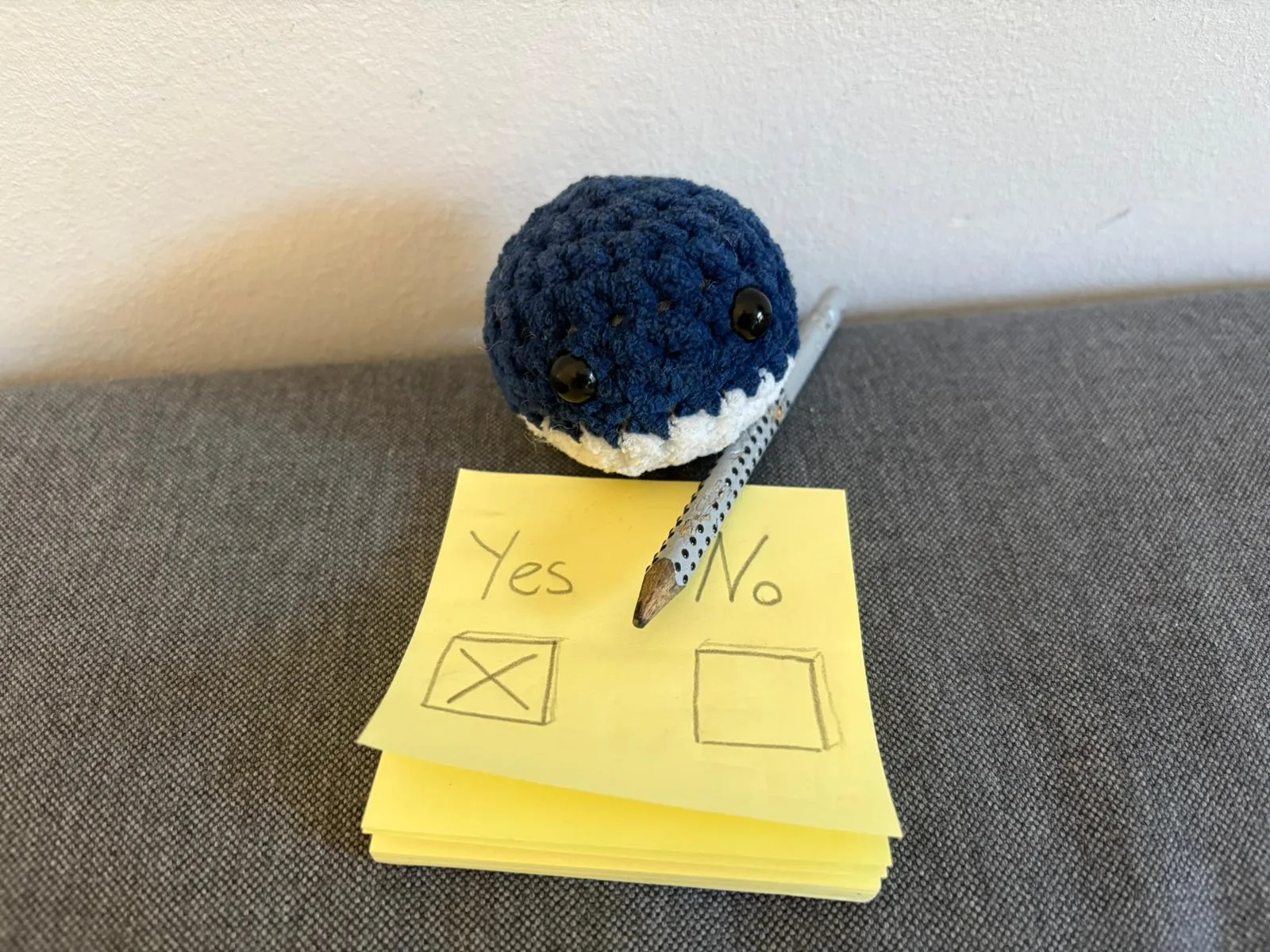
One late night a colleague and I were tossing ideas around. Most of them vanished with the beer. This one stuck. It started as a dumb joke, then it got oddly sharp, then I realized it was sharp in the wrong direction.
The pitch was simple: every ballot comes with four short questions about the parties' programs. Get them right, your vote counts. Miss them, it does not. A quiz at the booth. We laughed, and then we kept talking about it, because the laugh kept breaking against something real.
What it broke against was the experience of watching Austrian politics over the last decade or so. The ÖVP under Kurz campaigned on a Neuer Stil in 2017 and ended up at the centre of the largest corruption probe in the country's history. The 2019 ÖVP-Grüne coalition trimmed climate goals against everything either party had campaigned on a few months earlier. Most recently the FPÖ won the 2024 National Council election on Kickl's Volkskanzler framing and a long list of policy promises that immediately ran into the arithmetic of coalition formation. Across the border in Germany, the pattern is the same: half the campaign promises become coalition footnotes within months, and there is no formal mechanism that makes this expensive for anyone.
AI has now made political bullshit cheap to produce at industrial scale, and the supply will only grow. Every honest voter I know feels the gap between what gets said before an election and what gets done after, and the gap has no bridge.
So when someone proposes a sharp little gate that filters the most clueless votes out, part of you thinks: yeah, finally.
That part is wrong, but it's wrong in a way worth tracing carefully. The gate-instinct is responding to a real disease. The trick is figuring out what the disease actually is, where it sits, and what would actually treat it without breaking the patient.
What the gate gets wrong
The cheap rebuttals come first because they are not where the interesting argument lives.
Yes, a knowledge gate at the ballot box would be unconstitutional in Austria. Article 26 B-VG requires votes to be allgemein, gleich, unmittelbar, persönlich, frei und geheim, and a quiz breaks at least allgemein and gleich. Yes, the ECHR Article 3 Protocol 1 reading from Strasbourg has explicitly ruled out literacy or knowledge tests. Yes, the US Voting Rights Act of 1965 bans them by name because of how Jim Crow used them in practice. All of that is true, all of it is important, and none of it is what makes the quiz idea actually wrong at its root.
The deeper problem is that the quiz misunderstands what voting is for.
Most people have never had to articulate why they vote. The quiz forces the question. And once you ask it, you notice that several different theories of what voting accomplishes coexist in the modern democratic mind, mostly without anyone naming them.
You can think voting is information aggregation. Many votes pool into something more accurate than any single one (this is roughly the Condorcet jury theorem). On this view, what matters is whether the inputs are accurate, and uninformed votes pollute the signal. Filter them out, get a better signal. The quiz-gate fits this theory cleanly.
You can think voting is preference aggregation. People want different things, and democracy is how those wants get added up. Whether someone is "correct" about policy is not really the question. What matters is that their authentic preference appears in the count.
You can think voting is legitimation. A government is legitimate if it has been chosen by those it governs. The aggregation matters less than the authorization. Voting is what turns power into legitimate authority, regardless of how informed any individual ballot was.
You can think voting is co-authorship. Democracy is the system through which we collectively write the rules we then live under. Even uninformed votes assert co-authorship. Excluding people from authorship because their authorship is "uninformed" dissolves the very thing democracy is.
Modern democracy roughly settles on a mix of the second, third, and fourth theories. The first one, voting as information aggregation, sounds intuitive, but the moment you actually try to enforce it you end up with a literacy test at the door, and we know how that ended. Across roughly two centuries of pulling on this thread, we have collectively decided that the costs of treating votes epistemically are larger than the benefits. Gatekeepers drift toward whichever class controls the gates. Authorization breaks the moment you start excluding citizens from it. The legitimation function is corroded faster than the information function is improved.
So the quiz is not just morally bad because it would discriminate, although it would. It is categorically mistaken: it tries to apply quality control to a process that isn't primarily doing the thing it assumes the process is doing. It treats voting as an exam when voting is, mostly, a contract.
Where the quiz still points at something real
Walk the gate-instinct back, and the underlying intuition still has work in it. The intuition was that there is a real problem with how informed our political choices are. That problem is real. The mistake the gate makes is locating the problem on the voter side. The leverage is on the supply side.
Look again at the Austrian examples. The ÖVP did not break the Neuer Stil promise because voters were too dim to notice. Voters noticed. The party paid no formal price beyond a slow electoral one years later. The 2019 coalition compromise on climate did not happen because nobody read it. People read it. There is just no mechanism that turns "I read this and the party is now doing something different" into a consequence the party feels in real time. The promises themselves have the legal weight of a tweet.
This is what the quiz-gate intuition was actually pointing at. Not "voters are uninformed", but "the system has no formal mechanism to keep the supply of political claims honest between an election and the next one." The gate panics about voter quality because nothing else moves. It is the wrong fix, but the underlying alarm is correct.
The democratic answer to this is not to filter the demand side. It is to discipline the supply side. There are concrete tools for that.
Binding party-program archives. Wahl-O-Mat in Austria and Germany already nudges parties toward written-down positions. The next step is to make those positions binding-by-archive: a public, timestamped, signed record of what each party committed to before the election, hosted by an independent body, frozen on a published deadline. Independent watchdogs (think Faktencheck Austria or APA-Faktencheck) can then track delivery against record. This is not a law that forces parties to keep promises. It is infrastructure that makes broken promises a checkable, citable, repeated event instead of a generalized vibe.
Standardized voter information that parties cannot spin. Voter Information Pamphlets like the ones Oregon and Washington mail to every voter put each party's headline claims into a fixed format with equal length, plain language, and a timestamp. Austria has nothing comparable. The official ballot is bureaucratic theatre. The actual claim landscape is whatever parties pay to put on billboards and what platforms decide to amplify. A standardized pamphlet, sent to every household, takes a slice of that landscape and forces it through a single comparable filter. It is small. It is also the kind of small thing that compounds across decades.
Real ad transparency, enforced. The EU's Digital Services Act gives member states real teeth on political-ad disclosure. Most member states are not using them. A serious public ad archive, with full disclosure of who paid, what was said, when it ran, and on which platform, is a low-glamour intervention that already has the legal scaffolding. The 2024 Austrian campaign saw AI-generated political content circulating with no clear disclosure regime. Closing that hole is enforcement, not legislation.
Civic education that survives mid-secondary school. Austria's Politische Bildung curriculum reaches kids briefly in their teens and rarely after. Most adults' political education is whatever they happen to absorb during campaigning, which is structurally the worst-case curriculum because the people teaching it have an interest in obscuring rather than explaining. Long-term, the deepest lever is the one almost nobody campaigns on, because the payoff is decades out and the political return is zero.
None of these is a single-shot fix. None is as cute as a quiz at the booth. But each of them is treating the actual disease (a supply-side fog machine) instead of the wrong patient (the voter trying to read through it).
What survives once the gate is gone
The thing the quiz wants is a moment of forced clarity at the moment of decision. We cannot have that at the moment of voting itself, for good reasons. But we can have it everywhere upstream of the moment of voting: in the campaign, in the coalition, in the post-election delivery check.
That is the move. Don't make voting harder. Make lying harder. Make breaking promises more visible. Make the supply of political information less of a fog and more of a record. Each of those is a real lever. Each of those, unlike the quiz, actually strengthens democracy instead of trimming the people allowed to participate in it.
What I learned by being wrong
The colleague and I were treating voter ignorance as the problem. The actual problem is that parties operate in a near-zero accountability environment between elections, and voters have to make consequential decisions on the basis of evaporating claims. The fix is not a gate. The fix is to stop the evaporation.
Whenever I catch myself wanting to filter people out of a process to make the process work, that is usually a sign I have located the failure on the wrong side. Democracy does not need smarter voters. It needs a system that does not reward parties for being deliberately unclear about what they intend to do.
Democracy does not need a pop quiz. It needs less fog machine and more sentences that can be checked.
Comments